

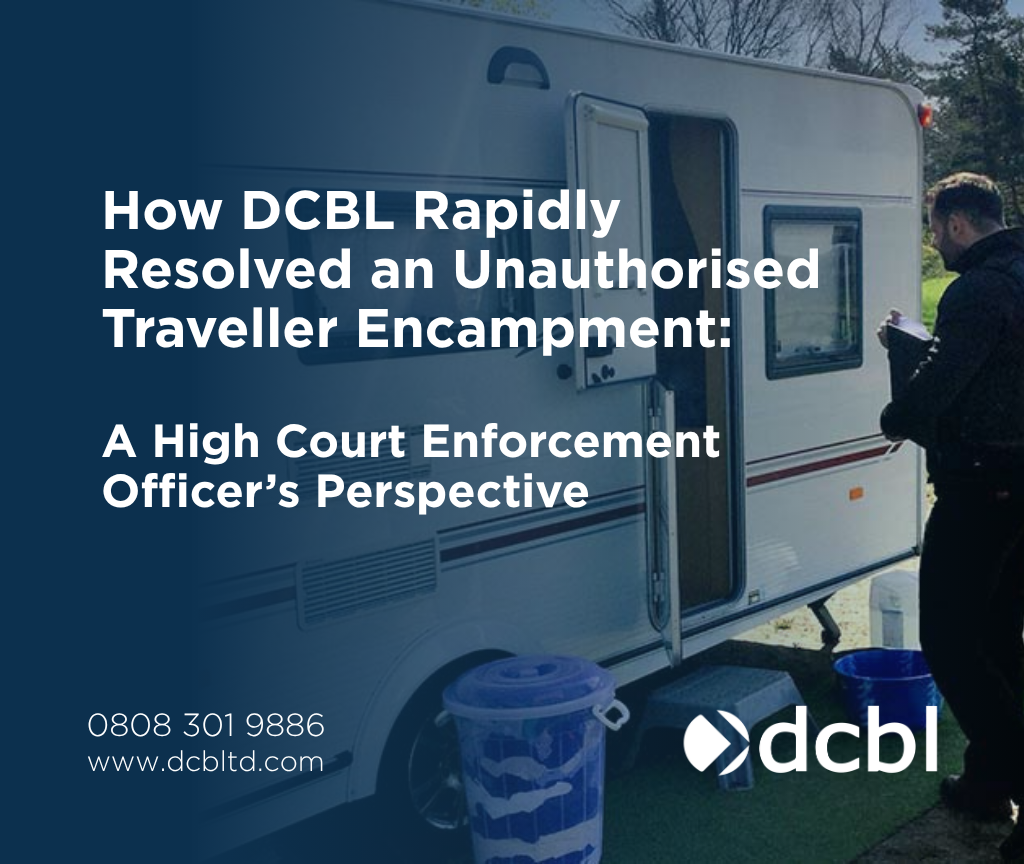




How DCBL Rapidly Resolved an Unauthorised Traveller Encampment: A High Court Enforcement Officer’s Perspective
27th March 2026
As a High Court Enforcement Officer with over 17 years of experience, I’ve worked closely with landowners, commercial property managers, and solicitors to resolve some of the most time-sensitive and complex possession issues, none more urgent than traveller evictions.
This information is designed to educate and reassure those responsible for commercial land and private property, and explain how traveller evictions work in practice. Many assume that once an unauthorised encampment is established, they are facing a lengthy, and potentially costly, eviction process. In reality, there are often faster, lawful solutions for private land owners available without court intervention.
Traveller Eviction Case Background
Recently, we were instructed on a live case that perfectly demonstrates how early intervention and the correct approach can resolve a situation quickly and professionally without unnecessary escalation. While I won’t disclose sensitive details, the outcome highlights what is possible when action is taken promptly to carry out a traveller eviction
At 6:30am, I received an urgent call from a client in Sheffield. They had just arrived at their commercial site to discover that an unauthorised group had gained access overnight.
The situation had escalated rapidly:
- Entry gates had been forced open
- Multiple vehicles were already on the land
- Access routes were obstructed, preventing staff and customers from entering
Understandably, the client was alarmed. This reaction is something we see frequently.
What is an unauthorised encampment?
An unauthorised encampment occurs when individuals occupy private land without the landowner’s consent. While this is a civil matter, it does not mean landowners are powerless.
Landowners often experience:
- “We must go through a full court process.” Not always true.
- “There’s nothing we can do immediately.” Incorrect.
- “We risk acting unlawfully if we intervene.” Only if the process is handled incorrectly
- “Only local authorities can carry out traveller eviction.” Local authorities can use the Criminal justice and Public order act, but any private land owner (including local councils) can instruct bailiffs without needing a possession order or writ of possession.
From an Enforcement perspective, there are lawful mechanisms to remove unlawful occupiers available that allow for swift action—provided they are applied correctly, proportionately, and with full compliance.
What are the mechanisms to traveller removal?
One of the most effective routes available to landowners is exercising their Common Law rights to regain possession of land.
In simple terms:
- Landowners may remove trespassers without a court order in most circumstances
- This must be done professionally, lawfully, only ever with reasonable force
- The process requires professional oversight to ensure compliance with legal and safety standards
The key factor is speed. The earlier action is taken, the more straightforward and controlled the situation remains.
At DCBL, we specialise in these scenarios and understand the importance of acting on the same-day. We ensure that action is not only fast, but also fully compliant.
In this instance, our response was immediate and coordinated:
- Rapid mobilisation: Upon instruction, certificated enforcement agents were deployed without delay
- Swift attendance: Our team arrived on site within hours and completed risk assessments for health and safety
- Professional engagement: We communicated directly with those occupying the land, maintaining a calm and controlled approach
- Legal compliance: All actions were conducted in line with current legislation and best practice
- Safe recovery: The land was cleared lawfully, without escalation or unnecessary disruption
Every step was carefully managed to protect the client, their property, and all individuals involved. Delays in responding to unauthorised encampments can significantly increase risk and cost.
Key risks include:
- Escalating damage to land and infrastructure
- Accumulation of waste and potential fly-tipping
- Increased security and clean-up costs
- Ongoing disruption to business operations
- Greater difficulty regaining possession as numbers grow
Acting quickly doesn’t just resolve the issue, it prevents it from becoming far more serious.
If you discover an unauthorised encampment, follow these steps:
- Stay calm – avoid confrontation or escalation
- Gather evidence – take photos or videos from a safe distance
- Do not attempt removal yourself – this can lead to legal and safety risks
- Contact DCBL immediately to discuss our traveller eviction services
- Allow us to manage communication and resolution
Why use DCBL when travellers arrive?
DCBL provides nationwide enforcement services across England and Wales, supporting both private and public sector clients.
Our service is built on:
- Specialist enforcement teams with extensive experience
- Rapid response capabilities
- Strict adherence to legal and compliance standards
- A professional, measured approach in high-pressure situations
We understand that every case is different, but our priority is always the same: resolve matters quickly, safely, and lawfully. In this case, the land was recovered swiftly and without complication.
Because the client acted immediately, disruption to their business was kept to a minimum, further occupation was prevented, and costs and damage were significantly reduced.
It’s a clear example of how early instruction leads to better outcomes.
Key Takeaways for Landowners
- There are same-day, lawful routes to regain possession of land
- Early intervention is critical in preventing escalation
- Professional enforcement ensures compliance and safety
- Delays increase risk, cost, and complexity
Always avoid direct confrontation and seek expert support
Contact DCBL today
If you are facing an urgent situation and need a same-day solution, or would like preventative advice, you can contact me directly:
- Email: ten@dcbltd.com
- Head Office: 0203 434 6132
- Emergency Line: 07719 976 384
We are available to respond quickly and guide you through the appropriate course of action 7 days a week.
At DCBL, we are committed to delivering enforcement services that are professional, compliant, and effective, especially when time is critical.
Unauthorised encampments can feel overwhelming, but with the right approach, they can be resolved quickly and lawfully.
If you have concerns, questions, or need immediate assistance, don’t hesitate to get in touch.
Traveller Eviction FAQ
How quick is the removal of travellers?
Do I need to issue court proceedings for removal?
Do I need to serve written notice before enforcement?
Are travellers considered squatters?
What legislation allows for removal?
What happens if they commit re-entry?
Are travellers committing a criminal offence?
Why use DCBL’s Certificated Agents to remove travellers?